EV SocietyElectric Vertical, Aerospace, Defence & Space Research Organisation

Featured Space Innovation Program

IN-SPACe Model Rocketry/CAN-7USAT India Student Competition

EV Society Space Innovation Awards 2026–27

Proposed by EV Society · Bengaluru, India

Two equal award-and-support pathways for the winning CAN-7USAT and Model Rocketry teams: an innovation award of ₹10,000 each, followed by 3 months of focused engineering development.

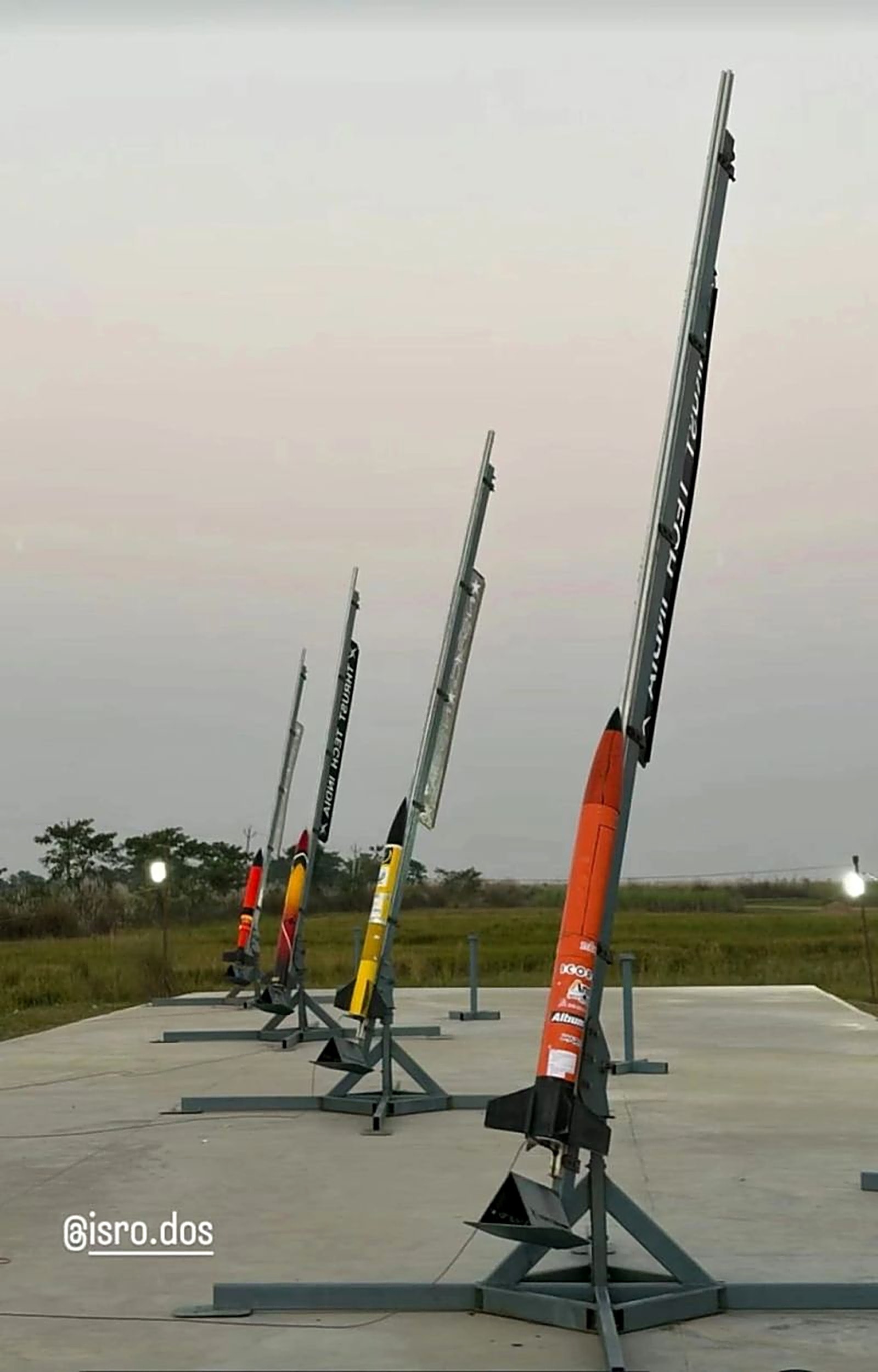
Four model rockets in orange, yellow and red stand ready on angled launch rails at an outdoor launch pad at dusk, with grassland and trees behind.
Photo: @isro.dos

Status: proposed. The awards, engineering support and dates on this page are EV Society proposals, subject to formal confirmation. The competition is organized independently by IN-SPACe.

About

A national competition, and a separate EV Society initiative

The competition

Organized by IN-SPACe

According to IN-SPACe, the 2026 competition gives undergraduate engineering and science student teams in India a realistic experience of designing and launching a model rocket that carries a 1 kg CAN-7USAT, provided by the organizers, to an altitude of 1,000 metres, with safe ejection of the CAN-7USAT and safe landing of the rocket.

Official IN-SPACe program page (IN-SPACe website, opens in a new tab)

The EV Society initiative

Proposed

EV Society Space Innovation Awards 2026–27

EV Society, Bengaluru, has proposed the EV Society Space Innovation Awards 2026–27 to recognise student innovation in space and rocketry, and to support the winning teams beyond the competition through focused engineering development.

These awards and the engineering support are EV Society's own proposed initiative. They are separate from the IN-SPACe competition, its rules and its judging.

EV Society team platform

Team profiles, participants and winners

Showcase your team's engineering talent, mentors and achievements. Profiles are reviewed by EV Society before they are published.

Awards & support

Two equal award-and-support pathways

Each winning team receives the same proposed innovation award and the same post-competition engineering development support.

CAN-7USATProposed

EV Society CAN-7USAT Innovation Award 2026

For the CAN-7USAT winning team

Innovation award
₹10,000
Engineering support
3 months
post-competition
Model RocketryProposed

EV Society Model Rocketry Innovation Award 2026

For the Model Rocketry winning team

Innovation award
₹10,000
Engineering support
3 months
post-competition

Total proposed awards

₹20,000

Both winning teams receive three months of focused engineering development support.

Engineering development

One problem. Three months. A working demonstrator.

After the competition, each winning team selects one defined engineering problem or subsystem from its own project and develops it over three months.

Objective

Turn a promising concept into a working, validated engineering demonstrator.

Proposed technical scope

Shared by both teams, applied as relevant to each team's project.

  • Physics-based modeling & simulation

    Build a physics-based model of the selected problem or subsystem and simulate its behaviour.

  • Nominal & fault scenarios

    Examine how the system behaves under expected conditions and under faults.

  • Telemetry, test & simulated-data comparison

    Compare simulated results against telemetry, test or other simulated data.

  • Health & performance estimation

    Estimate the health and performance of the selected problem or subsystem.

Timeline

Three-month development timeline

The same proposed sequence applies to both winning teams.

  1. Month 1

    Define & Model

    Define the selected problem or subsystem and model it.

  2. Month 2

    Build & Simulate

    Build the solution and simulate it.

  3. Month 3

    Validate & Demonstrate

    Validate the results and demonstrate the working system.

Final demonstration

Final submission & demonstration

The proposed milestone by which both winning teams submit and demonstrate their engineering demonstrators.

Proposed

Proposed deadline

Subject to confirmation for both teams.

Collaboration & contact

Collaboration and program contact

Proposed industry collaboration

Proposed

EV Society's proposal names the following organizations as prospective industry collaborators. Their involvement is pending verification and partnership confirmation.

Program contact

For questions about the EV Society Space Innovation Awards 2026–27. For competition rules, registration and results, please refer to IN-SPACe.

Sudarshana Karkala

For EV Society, Bengaluru, India

Official reference & disclaimer

The IN-SPACe Model Rocketry/CAN-7USAT India Student Competition is organized independently by IN-SPACe (Indian National Space Promotion and Authorization Centre). EV Society is not its organizer, and nothing on this page represents approval, sponsorship or endorsement by IN-SPACe.

The EV Society Space Innovation Awards 2026–27, including the award amounts, the three months of engineering development support for both winning teams, the collaborators named and the 15 February 2027 deadline, is EV Society's own proposed initiative and remains subject to formal confirmation.

For official competition information, eligibility, rules and announcements, please refer to IN-SPACe.

Photo: @isro.dos. Use of this photograph does not indicate association with, or endorsement by, its source.